THE JOURNAL
Appreciation of the Vacheron Constantin Métiers d'Art Skeleton Masculine Mechanical Watch
Vacheron ConstantinThe Métiers d’Art collection, released annually, features not only exquisite ladies' watches but also spectacular men's timepieces, with the latter boasting an even longer history. At this year's Salon International de la Haute Horlogerie in Geneva, Vacheron Constantin introduced 4 ladies' models alongside four men's watches titled Mécaniques Ajourées. While the men's collection may not be as visually dazzling as the ladies', the effort invested in them is equally significant.
An introduction to the Vacheron Constantin Métiers d’Art Mécaniques Ajourées masculine watch.
At first glance, these four watches are certainly more understated than the ladies' versions. They are distinguished by their indices, which come in black, grey, and blue, plus a black diamond-set version. Among these, the blue model is undoubtedly the most striking. The design of this collection is inspired by the central clocks found in railway stations. With the growing development of the railway system in the 19th century, major European stations became symbols of travel and cultural exchange. As the Industrial Revolution progressed, people's relationship with time changed dramatically, necessitating a unified standard for travellers. Consequently, large central station clocks emerged, with their bold, prominent Roman numeral indices providing a standard time reference for train schedules and passenger journeys.
Later, for both aesthetic and technical reasons, station architecture—representing progress and innovation—underwent large-scale reconstruction. Complex, compact station structures were redesigned to be simpler and more open. Arched doors and windows derived from Gothic architecture, along with fluidly lined ribbed vaults, met the demand for bright, airy concourses while effectively managing passenger flow. The Roman numeral indices, rendered through skeletonisation, not only evoke the vintage charm of central clocks in late 19th-century European railway stations but also embody the essence of architectural aesthetics.
Unlike the vibrant enamel dials of the ladies' watches, these four models opt for more understated, restrained monochrome enamel. While the colour palette is reduced, this does not imply a decrease in manufacturing difficulty. Without exception, all four watches utilise Vacheron Constantin's signature Grand Feu enamel technique. Enamelling is an ancient craft that must be performed entirely by hand; even with today's advanced technology, no mechanical equipment can replace the enamel artisan. In Grand Feu enamelling, the master carefully paints the decorative colours on the outer ring beneath the Roman numerals stroke by stroke; the slightest error would compromise the aesthetic integrity of the circular pattern.
Achieving light and shadow transitions with deep black using the Grand Feu enamel technique is a particularly high-level challenge. The darker the colour, the more light it reflects, making even the smallest flaws glaringly obvious. To highlight the richness of the black, the enamel master must create a perfectly smooth and uniform surface to prevent air bubbles during the subsequent firing processes—a requirement that applies equally to the other two colours.
This watch not only features a profound design, but its greatest highlight is undoubtedly the skeletonised movement it houses. The 4400SQ movement featured in this watch is a skeletonised version of Vacheron Constantin's most famous manual-winding movement, the 4400, and marks the first time Vacheron Constantin attempted to skeletonise a classic in-house movement. To address the trend for larger watches, Vacheron Constantin launched the successor to the 1400 movement in 2009, the all-new 4400 movement. Compared to the 1400, the most obvious difference is that the diameter has increased by 8 millimetres, with a subsequent increase in power reserve from 40 hours to 65 hours. Compared to the 1400 movement, the 4400 hides the large steel wheel and exposes the small steel wheel; however, the small steel wheel does not feature a more textured satin finish, but rather a common polished finish. Furthermore, the gear train is no longer split, becoming a single bridge, and it lacks an escapement shock absorber.
To be honest, I was not particularly fond of the solid-dial version of the 4400. While this movement surpasses its predecessor in practicality and inherits some of its stylistic legacy, the overall aesthetic feels more modern and technical. While I am not in a position to judge whether this style is good or bad, it feels as though it lacks that unique traditionalism and delicacy characteristic of Vacheron Constantin. Regarding the omitted details I mentioned, some might argue they are insignificant, but I believe the essence of high-end watchmaking lies in how a brand handles those very details, as the premise of haute horlogerie is to achieve perfection regardless of cost.
However, upon seeing the skeletonised 4400SQ movement, all my prejudices vanished. Its beauty is simply stunning, particularly the sharp, triangular engravings on the barrel and balance wheel. Although the two movements share the same lineage, I could find no trace of the solid version; it is an entirely new movement. Its appearance makes me feel as though I have returned to a historic European railway station, looking up at the glass dome supported by the ribbed vaults characteristic of Gothic architecture.
It is no exaggeration to say that this movement, which has undergone hundreds of hours of meticulous carving, has pushed the art of skeletonisation to its limit. By successfully removing nearly half the material from the solid 4400 movement, the watchmakers faced a significant challenge: reducing material inevitably leads to deformation, doubling or even tripling the risk of component warping. Yet, relying on their extensive experience and profound skill, the watchmakers repeatedly refined each part, ensuring that all components function together flawlessly—a true feat of engineering. Any over-correction would have required the engraver to start the process all over again.
To create the unique three-dimensional interplay of light and shadow found in architectural aesthetics, Vacheron Constantin invested immense effort into the engraving. As with other skeletonisation processes, the movement underwent a lengthy conceptualisation, design, and modelling phase based on the existing solid calibre. Once completed, rather than using traditional micro-saws to skeletonise the mainplate and bridges, the engraver meticulously carved the entire circumference of the movement to create a truly three-dimensional visual effect comparable to a sculpture, before proceeding to manual filing and bevelling.
Drawing inspiration from the ribbed vaults of late 19th-century railway station halls, the engraver used a burin to carve delicate arched motifs into the movement. These motifs subvert the typical straight lines of skeletonised movements, incorporating more complex bevelling techniques and manual finishing. To create intricate, interlacing textures, some internal angles smaller than 45 degrees could only be finished by hand. Furthermore, to ensure the polished areas capture more light and make the movement appear more crystalline, certain sections required manual matte finishing. Consequently, the skeletonisation of the movement frame alone required at least three days. Through the clever combination of various manual finishing techniques, the movement not only perfectly presents its unique relief effect, but the entire watch has also earned the prestigious Hallmark of Geneva certification.
Although Vacheron Constantin did not launch its first fully skeletonised movement until 1924, the brand has never ceased its relentless pursuit in this field. As a pioneer, leader, and innovator in skeletonisation, we sincerely hope that Vacheron Constantin will continue to introduce even more exquisite skeletonised creations in the future.
Having read this far, I recommend a popular Vacheron Constantin watch to you; please add WeChat for further inquiries.
Vacheron Constantin Patrimony collection 85180/000R-9248
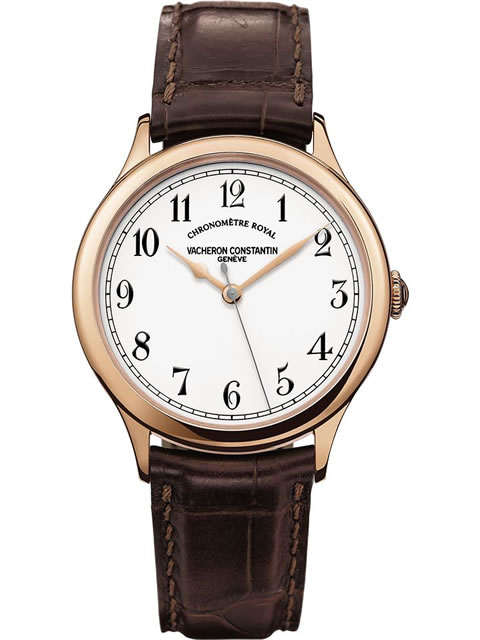
Review:
◆ 40 mm size, pink gold case, engraved with the Hallmark of Geneva, elegant and refined in appearance with a poised and generous temperament.
◆ Rose gold case paired with a brown alligator strap, classic! The watch is also very slim, the movement is quite good, and it is well worth collecting.
◆ Silver opaline dial with a curved edge design, the timekeeping section is finished with circular graining, and it features gold applied hour markers.
◆ Features sapphire crystal, which is robust and scratch-resistant
◆ Water resistance reaches 30 metres, meeting daily requirements
Summary: Vacheron Constantin watches combine peerless performance with unique design, creating exemplary pieces that embody the pinnacle of high watchmaking artistry. The Vacheron Constantin watch recommended here features fine workmanship and guaranteed quality. Friends wishing to purchase may add WeChat for enquiries.
You might also like:
Vacheron Constantin and the Qing Imperial Court
The Affinity Between Vacheron Constantin and China
Vacheron Constantin Dark Grey Dial Watch - Understated and Refined
Introduction to Vacheron Constantin Historical Masterpieces Collection Watches
Vacheron Constantin Forging a Century of Brilliance
![[N Factory Perfect Edition] Rolex Submariner series mechanical watch 116613LN](/images/pic/big/3940.jpg)
![[VS Factory Perfect Edition] Panerai Modern LUMINOR 1950 Series PAM00441 Watch](/images/pic/big/3873.jpg)
![[Noob Factory V7 Edition] Rolex Submariner watch 116610LN Black Sub](/images/pic/big/4977.jpg)
![[Noob Factory V7 Version] Rolex Submariner Watch 116610LV Kermit Submariner](/images/pic/big/4976.jpg)