THE JOURNAL
The Diamond Legend of Cartier
The history of diamonds is akin to an endless book of poetry, filled with legend and adventure. Every single chapter is imbued with humanity's burning passion for this gemstone spanning thousands of years. From royalty and nobility to socialites,Cartierrare diamonds are always inextricably linked with legendary tales. In 1928, commissioned by Sir Bhupindar Singh, the Maharaja of Patiala, Cartier created a grand ceremonial necklace set with 2930 diamonds with a total weight of nearly 1000 carats, including a rare yellow diamond weighing 234.69 carats. In 1956, Prince Rainier III of Monaco proposed to Grace Kelly with an emerald-cut diamond ring weighing 10.48 carats produced by Cartier. In 1981, Queen Elizabeth II of Great Britain wore a Cartier floral brooch set with the Williamson pink diamond to attend the wedding ceremony of Prince Charles, witnessing an important moment for the British royal family...
Of all nature's wonders, only the king of gemstones, the diamond, is able to play such an important role in various adventures and love stories. Every single diamond tells a gripping tale.
Cartier Diamond Stories
1. The Star of the South
In 1853, a slave discovered a rough diamond weighing 261.24 carats in a Brazilian mine. Due to its exceptional size and superb quality, the slave was granted his freedom and provided for for the rest of his life. Named the 'Star of the South', the diamond was cut several times to a final weight of 128.48 carats, and was set alongside the famous Dresden pear-shaped white diamond in a magnificent necklace cherished by Baroda Sayaji Rao, the Maharaja of Baroda, for nearly eighty years. Although not as dazzlingly brilliant as white diamonds, the charm of the 'Star of the South' remains irresistible. Its inner radiance is as soft as cotton, and when touched by light, it emits a continuous, gentle pink glow. In 2002, Cartier set this peerless diamond into a bracelet, breathing new life into it.
The 12-year-old Maharaja of Baroda wearing the 128.48-carat 'Star of the South' diamond necklace.
Originally owned by the Maharaja of Baroda, the 'Star of the South' pink diamond is the sixth-largest cut diamond in the world. Cartier set it into a bracelet in 2002.
2. The Williamson Pink Diamond
In 1947 10, a young boy discovered a rough diamond weighing 54.5 carats under a baobab tree in a mining area owned by geologist Dr John Williamson. Admiring the British royal family, Dr Williamson decided to present it to then Princess Elizabeth as a wedding gift on 1947 11 20. After months of meticulous carving, a nearly flawless pink diamond weighing 23.6 carats was finally achieved. When Princess Elizabeth ascended the throne as Queen in 1953, she commissioned Cartier to design a snowdrop-shaped brooch featuring this diamond as its centerpiece. The brooch used baguette-cut diamonds for the stem, two marquise-cut diamonds for the leaves, and round brilliant-cut diamonds for the petals. This legendary piece of jewellery was exhibited at the 'Diamonds: A Jubilee Celebration' exhibition held in London in 1959. Queen Elizabeth also wore this brooch at Prince Charles's wedding ceremony in 1981. To this day, this snowdrop frequently graces the Queen's lapel.
A floral brooch set with the 'Williamson' pink diamond. Queen Elizabeth II frequently wears the floral brooch set with the 'Williamson' pink diamond.
3. The Hope Diamond
The origin of the 'Hope' diamond is as mysterious and unfathomable as its deep blue hue. It is said to have originated from the Kollur mine near Golconda in India—the birthplace of legendary gemstones—and was originally set into the eye of an Indian deity statue. This is just one of many legends full of mystery surrounding this diamond, and the 'Hope' diamond always retains its own primordial mystery.
In 1668, the renowned French traveller Jean-Baptiste Tavernier acquired this diamond during his travels in India and sold it to Louis XIV. Upon its arrival in France, this blue diamond was named the 'Rose of Paris'. It was not until 1673 that Louis XIV had craftsmen recut it into a 69.03-carat diamond, naming it the 'Blue Diamond of the Crown'. Subsequently, at the request of Louis XV, it was set into the Order of the Golden Fleece, a symbol of supreme power. In 1774, Louis XVI wore this very insignia at his coronation ceremony.
However, pomp and pageantry soon changed, and following the outbreak of the French Revolution in 1792, this famous diamond vanished. In the early 19 century, it reappeared in London, weighing 45.5 carats, and belonged to the British merchant Eliason. For the next 20 years, the whereabouts of this legendary diamond remained unknown once again, until around 1839 when Henry Philip Hope, an Amsterdam banker, passed away, and the Hope diamond, named after his family, reappeared in the world. Afterwards, the Hope family kept it until later descendant Lord Francis declared bankruptcy in 1895, and it was eventually acquired by Cartier, who transformed it into a magnificent pendant clustered with fine diamonds.
Around 1910, Evalyn Walsh McLean, heiress to The Washington Post, acquired this world-famous Hope diamond from Cartier. "Pierre Cartier lent it to us to view before the sale, and I was immediately captivated. One night, alone at home, I couldn't help staring at this diamond for several hours, and from a certain moment, I began to desire it intensely. When it finally belonged to me, my heart was filled with happiness." Around the same time, her father presented Evalyn with a diamond named the Star of the East as a wedding gift; this pear-shaped diamond from India weighed 94.8 carats and was mounted by Cartier on an egret-feather head ornament. The wealthy American socialite could not hide her excitement when speaking of the Star of the East diamond: "It captured my heart!"
Madame Evalyn Walsh McLean was a loyal patron of Cartier US, wearing the egret-feather head ornament set with the Star of the East diamond and the necklace set with the Hope diamond, purchased in Paris in 1910.
In 1910, Cartier crafted the 45.52-carat Hope diamond into a pendant clustered with fine diamonds.
4. The Pasha of Egypt Diamond
Brilliant, hard, and indestructible, the diamond symbolises unshakable power. In 1933, the world-renowned legendary diamond, the Pasha of Egypt, was sent to Cartier London via T. M. Sutton. This gemstone of mysterious origins was bought by the Pasha of Egypt in 1848 and retains that name to this day. It briefly lost its whereabouts before reappearing in the world and being purchased by American socialite Barbara Hutton. However, Barbara was not entirely satisfied with its octagonal shape and requested that it be recut and mounted as a ring. Nearly two carats of diamond were turned into powder simply to please this "million-dollar lady". Its glamorous appearances at the Venice Bevilacqua Ball and the palaces of Tangier in Morocco left a lasting impression. The weight of the Pasha diamond was reduced again in the 1980s, with a final weight of 36.22 carats.
Barbara Hutton in her villa in Tangier, Morocco. She is wearing the emerald tiara created by Cartier in 1947, which once belonged to Grand Duchess Maria Pavlovna, wife of Grand Duke Vladimir. On her hand, she wears the renowned Pasha diamond (36.22 carats).
5. The Cartier-Taylor-Burton Diamond
The Cartier-Taylor-Burton diamond initially weighed 240.80 carats when discovered in the South African Premier Mine in 1966. On 12 11, 1969, this rare pear-shaped diamond, cut to 69.42 carats, was finally won by Cartier at a New York auction for the astronomical price of $1,050,000, becoming the first diamond in history to sell for over a million. Consequently, the diamond was named after the jeweller as the "Cartier Diamond". Soon after, Hollywood actor Richard Burton sought to purchase this diamond from Cartier, naming it the Taylor-Burton Diamond and presenting it to his beloved Elizabeth Taylor as a token of love. At Taylor's request, the diamond, originally mounted as a ring, was converted into a necklace pendant.
Taylor's first public appearance wearing the Taylor-Burton diamond was at the fortieth birthday gala of Princess Grace of Monaco, the dazzling brilliance of the diamond highlighting her joyful expression in the battle of love and fame. Taylor and Richard Burton married twice, and their love did not prove as eternal as the diamond, but this Taylor-Burton diamond has been celebrated by the world forever. As time passed and the beauty grew older, Elizabeth Taylor remarked in her later years: "Perhaps diamonds cannot give you something to lean on when you are disappointed, nor keep you warm in the dead of night, but under the bright sunshine, they are such a joy."
6. The Star of South Africa
In 1869 in a small town south of the Vaal River in South Africa, a shepherd boy traded a 83.5-carat rough diamond with a neighbouring farmer. The farmer exchanged 500 sheep, 10 oxen, and his only horse for the gemstone. The Star of South Africa was the first flawless diamond unearthed in Africa and also the first gem-quality diamond in history, attracting tens of thousands of prospectors to South Africa to "hunt for diamonds". It is said that shortly after its discovery, the Star of South Africa was exhibited in parliament, where an MP publicly declared: "Gentlemen, this diamond is where the future prosperity of South Africa lies." It was subsequently sent to Amsterdam in the Netherlands, ultimately cut into a 47.69-carat pear-shaped beauty, and sold to the second wife of the Duke of Dudley, who named it after herself and wore it as a head ornament. In the late 1910s, Cartier designed the Star of South Africa into an Old European-cut lily-of-the-valley brooch.
The Star of South Africa is the first gem-quality diamond in history, crafted into a brooch by Cartier New York in the late 1910s.
7. The Louis Cartier Diamond
The "Louis Cartier" diamond is "the size of a baby's fist", weighing 107.7 carats, cut from a 400-carat South African rough stone. This extraordinary teardrop-shaped diamond is one of the very few ultra-large diamonds exceeding 100 carats to still be graded as D colour, flawless by the Gemological Institute of America (GIA). In 1976, marking the centenary of Louis Cartier—the third-generation family heir and former guiding spirit of Cartier—the "Louis Cartier" diamond was exhibited in the Cartier showroom in New York and later purchased by a European collector. At the time, the insurance valuation for this diamond was as high as five million US dollars.
The Louis Cartier diamond weighs over 100 carats and is graded as D colour, flawless by the Gemological Institute of America. Its name is taken from Louis Cartier, the third-generation family heir of Cartier.
8.Jubilee Diamond
In 1895, one of the largest and most famous white diamonds in the world was discovered in the Jagersfontein mine in South Africa, weighing 650.8 carats. In 1897, coinciding with the 60 diamond jubilee of Queen Victoria's accession, the rough diamond was sent to Amsterdam in the Netherlands, where a lapidary cut it into a 88-facet, 245.35-carat diamond. The Jubilee diamond took its name from this innovative memorial cut. This technique, combining the rose cut and the brilliant cut, was entirely new at the time and remains extremely rare even today. In 1900, the Jubilee diamond was exhibited at the Paris Exposition. In 1935, this diamond, which was then the fourth largest in the world, was sold by Cartier in London to the French industrialist and art patron Paul-Louis Weiller. It was originally designed as a long plume ornament for a turban, but because feathers failed to showcase the transparent brilliance of this fine diamond, Jeanne Toussaint, Cartier's creative director of fine jewellery at the time, transformed it into a highly contemporary turtle-shaped brooch.
In 1937, Jeanne Toussaint created a turtle-shaped brooch inspired by the Jubilee diamond.
9. The Anat Diamond
The Anat Diamond weighs 102.07 carats and exhibits an incredible, delicate yellow hue. It takes its name from its previous owner, Major Anat, a military officer and connoisseur of art and horses. In the early 1950, Major Anat entrusted the diamond to Cartier to be set into an exquisite floral brooch, with petals composed of diamonds in various cuts including brilliant, baguette, round and square.
Weighing 102.07 carats, the Anat Diamond was discovered in 1881. In 1952, Cartier created an exquisite floral brooch using this rare diamond.
From the Star of the South to the Williamson, and from the Hope blue diamond to the Pasha of Egypt diamond, Cartier infuses legendary diamonds with soul, igniting their hidden inner light and combining fluid dynamism with intricate structure to create an enduring diamond legacy.
Having seen this, I recommend a popular Cartier watch to everyone. Those who want to know more can add WeChat to consult.
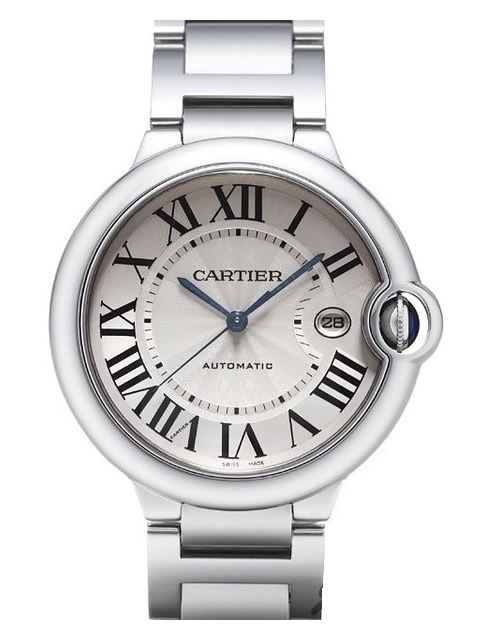
Cartier Ballon Bleu automatic mechanical watch W69012Z4
Review:
◆ The latest version of the Cartier Ballon Bleu W69012Z4, featuring mature replica craftsmanship, with several details refined in this latest edition.
◆ Ballon Bleu is Cartier's most recognisable series and an essential statement piece for social occasions.
◆ The material and craftsmanship of the sapphire crown have been improved. All engravings on the case and bracelet are clearer, closely resembling the genuine article. The lustre of the blued steel hands at specific angles is also comparable to the original.
◆ The dial markings are more precise and carefully executed, representing a minor improvement and showing that the manufacturer has addressed consumer feedback.
◆ On the black chequered dial, the classic Roman numerals at the three and six o'clock positions have been replaced by small sub-dials for minutes and seconds, while the date window has been moved next to the nine o'clock marker. Standard chronograph pushers are positioned on either side of the sapphire crown, allowing you to master the passage of time with every press.
Conclusion: Cartier watches are known for their precision mechanics and exceptional quality, and their professional technology is loved by watch enthusiasts. The Cartier watch recommended to everyone is exquisitely crafted with guaranteed quality. Friends who wish to purchase can add WeChat to consult.
You might also like:
How to wear a Cartier watch? Cartier watch wearing methods
How is the Cartier watch w6900651?
How is the Cartier Ballon Bleu series?
Is the brand awareness of Cartier watches high?
How much does Cartier watch maintenance cost?
![[N Factory Perfect Edition] Rolex Submariner series mechanical watch 116613LN](/images/pic/big/3940.jpg)
![[VS Factory Perfect Edition] Panerai Modern LUMINOR 1950 Series PAM00441 Watch](/images/pic/big/3873.jpg)
![[Noob Factory V7 Edition] Rolex Submariner watch 116610LN Black Sub](/images/pic/big/4977.jpg)
![[Noob Factory V7 Version] Rolex Submariner Watch 116610LV Kermit Submariner](/images/pic/big/4976.jpg)