THE JOURNAL
The undeniable romances between four legendary women and Cartier jewellery
The moving story of every legendary woman is never short of world-renounced beauty and formidable character. As these stories are passed down through the generations, the dazzling jewels they once cherished shine like magnificent stars, emitting an eternal radiance across the vast expanse of time. From the Duchess of Windsor, who created a legendary romance, to the daring socialite Daisy Fellowes, the captivating American silent film star Gloria Swanson, and María Félix, an actress known as 'the most beautiful face in the history of Mexican cinema', piece after piece of peerless jewellery crowned their legendary elegance and etched the most enchanting scenery onto their respective eras. Next, let us experience the undeniable romance between four legendary women andCartierjewellery.
The Duchess of Windsor: A romantic tale and tradition-breaking jewellery
Wallis Simpson, who wrote a sensational love story with King Edward VIII (who abdicated to become the Duke of Windsor), had already caught many eyes with her noble posture and witty conversation upon first entering British high society, even before encountering the passionate monarch's ardent pursuit. In the 1920s, many restaurants refused to admit women wearing trousers, viewing the style as avant-garde and unconventional; yet Simpson donned a chic, short haircut and a white linen trouser suit for an appearance in a top fashion magazine.
Her most memorable ensemble, however, appeared on her wedding day to the Duke of Windsor. She wore a pale blue silk satin dress, accessorised with a Cartier crucifix pendant bracelet. 9 platinum crucifix pendants, paved respectively with aquamarines, emeralds, rubies, yellow sapphires, amethysts, and baguette-cut diamonds, marked the most significant moments of her life, with a personal inscription handwritten by the Duke on the reverse of each. 'God Save the King for Wallis, 16.VII.36' is among the most touching, referring to the incident on 1936 7 16, when the then Edward VIII miraculously escaped unhurt from an assassination attempt while horseback riding near Buckingham Palace.
This tender declaration of love, engraved upon everlasting jewellery, witnessed the deep and moving romance of the Duke and Duchess every step of the way. 'We are ours now...', a phrase denoting rebellion and devotion, remains forever on the Duchess's Cartier platinum engagement ring, set with a 19.77-carat emerald. Two decades later, to celebrate their wedding anniversary, the Duke of Windsor presented her with another Cartier creation: a heart-shaped diamond brooch set with emeralds forming the initials 'WE', accompanied by a yellow gold crown and Roman numerals 'XX' (twenty) formed from rubies.
To ensure his beloved became the 'best-dressed woman in the world', the Duke of Windsor commissioned countless pieces from Cartier for her throughout his life; the doting Duchess once received a presentation box containing 57 Cartier pieces. Behind these creations made for the Duchess of Windsor stood an exceptional Cartier artist, the legendary woman who headed the Cartier high jewellery department and was known as the 'Panther Lady': Jeanne Toussaint. She designed many unconventional pieces for the Duchess, most famously the diamond panther brooch perched atop a 152.35-carat cabochon Kashmiri sapphire, imparting a bold, feline self-assurance beneath the Duchess's poised and feminine attire.
Soft pearls and deep sapphires were among the Duchess's favourites; she once remarked that sapphires best accentuated the colour of her eyes. A striking piece of jewellery often served as the focal point of the Duchess of Windsor's attire. Whether it was the Cartier flamingo brooch adorning the collar of her black-trimmed white coat during a holiday in Bermuda, or the bib necklace of gold set with diamonds, amethysts, and turquoise worn at a glamorous Venetian dinner, her eye-catching designs allowed her to radiate an elegance that remained entirely her own.
Daisy Fellowes: Jewellery of trans-epochal aesthetics and exotic allure
Darling of high society, talented writer, and fashion creator—Daisy Fellowes bridged multiple roles and was undeniably a maverick woman of her era. Born into a wealthy and high-ranking Parisian family, her father was a descendant of the chief minister to Louis XVIII of France, her mother was the daughter of the sewing machine tycoon, and her second husband (Reginald Ailwyn Fellowes) was a relative of British Prime Minister Winston Churchill. Daisy Fellowes was both a friend and a stylistic rival to the Duchess of Windsor (the latter's panther brooch prompted Fellowes to immediately commission a similar piece from Cartier). Elsa Schiaparelli, the daring couturière, was a close friend profoundly influenced by her; Schiaparelli's signature shade, 'Shocking Pink', drew its creative inspiration directly from Fellowes's 17.27-carat pink diamond purchased from Cartier.
If Daisy Fellowes's naturally privileged upbringing nurtured her fine taste, then her bold, individual personality projected a truly unique charm. During the Roaring Twenties, an era eager to shake off the oppressive atmosphere following the First World War and break free from traditional shackles, modern women eagerly cropped their hair close to their ears and donned dresses considered as daring as those of showgirls, with Daisy Fellowes standing out as one of the most striking among them. A photograph in 1927 Vogue magazine regarding Parisian women's new hairstyles recorded the moment she first caught the fashion world's attention: a short haircut crafted by a renowned stylist, covered in curls at the forehead and behind the ears, paired with a sequined long suit jacket worn over a classic top. In an era when cotton and linen fabrics were restricted solely to daytime attire, she boldly chose them for evening wear; at race days where every woman vied to outshine the others with millinery, she appeared completely hat-free; and at afternoon tea parties surrounded by floral long dresses, she turned up in leopard-print pyjamas.
Interestingly, when it came to wearing jewellery, she insisted on traditional pairs ("Why should your arms and hands feel unbalanced on either side?" she once remarked), yet remained boldly extravagant in her choice of colours and shapes. She chose to pair her minimalist outfits with wildly styled emerald bracelets, Indian-inspired pieces filled with red and green tones, and records even show she accessorised with magnificent jewellery while wearing swimwear. Her unwavering commitment to herself kept her perpetually peerless.
The famous Tutti Frutti style necklace created by Cartier is among her surviving collection of heirloom jewellery: at a masked ball held in Venice in 1951 by the European millionaire Don Carlos de Beistegui, Fellowes arrived dressed in a leopard-print chiffon evening gown, with a necklace composed of red, blue and emerald gemstones successfully making her the centre of attention that evening. This necklace, created in 1936, drew inspiration from a bespoke design Cartier crafted for an Indian prince. Interestingly, while blue was regarded as an ominous colour in traditional Indian culture, Fellowes defied past conventions by incorporating it nonetheless. This iconic Cartier creation vividly demonstrated her avant-garde aesthetic, which transcended eras and defied conventional norms.
Gloria Swanson: Dazzling Hollywood and Art Deco Jewellery
Gloria Swanson, the greatest American actress of the silent film era, can be considered another representative figure of Roaring Twenties style. Hailing from outside high society, she lacked a substantial fortune to provide her with abundant styling resources, yet every expression and smile of hers on screen captivated countless fans. In an era when haute couture was reserved exclusively for the rich, her magnificent attire became the fashion trendsetter for women at the time. Whether in early works like Fine Manners and The Gilded Cage, or in artistic explorations during the peak of her career such as Sadie Thompson, the petite actress was constantly surrounded by lavish peacock and ostrich feather decorations, layered pearl necklaces, and gorgeous gowns filled with velvet and lace. Swanson naturally became one of the first actresses to gain attention because of fashion, with each of her films drawing women into cinemas to catch a glimpse of the latest style trends.
In the rather pioneering film Stage Struck, Swanson echoed a black slip dress with a geometric brooch, which not only reflected society's passion for Art Deco at the time, but also initiated her future romance with magnificent jewellery.
In the mid-nineteen twenties, Swanson reached the first peak of her career. Her contract with the film studio included a special clause: she was required to wear the latest fashion and jewellery when appearing in public. Although the clause required her to pay for these herself, the actress, who had become the highest-paid star in Hollywood at the time, gladly accepted, as she had an infinite love for jewellery, spending up to five hundred thousand dollars on it annually. With her 1950 film Sunset Boulevard, Swanson reached the second peak of her career. The Cartier "white Art Deco style" platinum and diamond-set crystal bracelet worn by the reclusive silent film star in the movie—a character who seemed to be a reflection of herself—had also appeared on the poster for the 1933 film Perfect Understanding. This bracelet, which she cherished deeply, became the most iconic piece of jewellery for this glamorous star.
María Félix: Wild Exoticism and Vivid Animal Jewellery
Praised as "the most beautiful face in the history of Mexican cinema", María Félix became the first internationally successful Mexican actress with her mysterious, wild and seductive disposition. From the 1940 to the 1970 decades, she created 18 films, portraying numerous dazzling screen personas. Particularly in the film French Cancan, she brilliantly interpreted the late-eighteenth-century French socialite La Belle Otero, while pushing her personal glamorous image to its absolute zenith.
In her daily attire, Félix liked to integrate her homeland's style into haute couture fashion. A straw hat adorned with a turban, a printed scarf tied around her neck, and a white off-the-shoulder dress with a flowing voluminous skirt, complemented by jewellery layered in stacks on her arms and wrists, brought out a rich exotic flair. Her unique charm attracted numerous artists—including Leonora Carrington and Diego Rivera—to paint her portrait, yet what became even more widely talked about was her exquisitely luxurious jewellery collection.
In 1955, Félix commissioned Cartier to design a necklace: a string of lily-of-the-valley-shaped coral pendants threaded along a matching coral bead chain, with a platinum-set diamond and onyx clasp incorporating the brand's signature Art Deco style. She was utterly enchanted by this necklace, and it became one of Félix's most frequently worn pieces of jewellery. Another even more legendary piece of jewellery—a necklace featuring two intertwined crocodiles—also came from Cartier. It is said that in order to vividly replicate the crocodiles' postures, Félix brought her two pet baby crocodiles to the Cartier boutique. This necklace, which could be disassembled into two brooches, utilised a total of 66.86 carats of 1060 emeralds alongside 60.02 carats of 1023 yellow diamonds, representing a breathtaking combination of jewellery artistry and craftsmanship.
Meanwhile, a platinum-set diamond serpent necklace she commissioned from Cartier in 1968 was equally astonishing. This necklace was completely paved with diamonds totalling 178.21 carats. The three-dimensional setting gave the entire necklace not only a lightweight form, but also a lifelike appearance. Drawing inspiration from the aerospace sector, Cartier invented a clever miniature mechanism that rendered the necklace supple and flexible, with an incredible range of stretch. Nearly two decades later at a public appearance in 1981, Félix paired it once again with a wide-brimmed straw hat and a plain fringed long dress, allowing this creation, which bordered on being an artwork, to radiate a truly unique elegance.
Having seen this, I recommend a popular Cartier watch to everyone. Those who want to know more can add WeChat to consult.
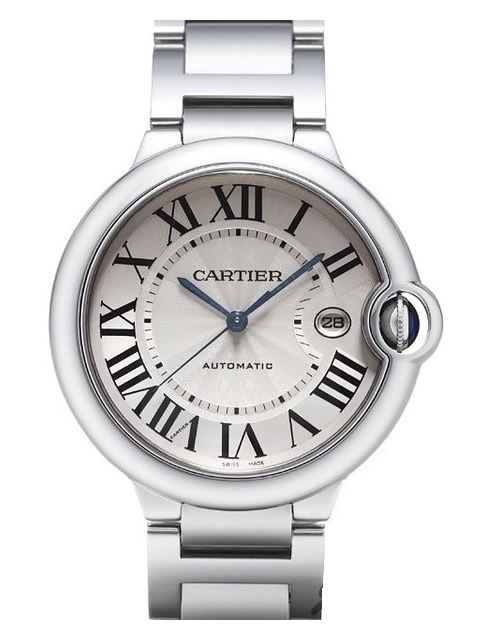
Cartier Ballon Bleu automatic mechanical watch W69012Z4
Review:
◆ The latest version of the Cartier Ballon Bleu W69012Z4, featuring mature replica craftsmanship, with several details refined in this latest edition.
◆ Ballon Bleu is Cartier's most recognisable series and an essential statement piece for social occasions.
◆ The material and craftsmanship of the sapphire crown have been improved. All engravings on the case and bracelet are clearer, closely resembling the genuine article. The lustre of the blued steel hands at specific angles is also comparable to the original.
◆ The dial markings are more precise and carefully executed, representing a minor improvement and showing that the manufacturer has addressed consumer feedback.
◆ On the black chequered dial, the classic Roman numerals at the three and six o'clock positions have been replaced by small sub-dials for minutes and seconds, while the date window has been moved next to the nine o'clock marker. Standard chronograph pushers are positioned on either side of the sapphire crown, allowing you to master the passage of time with every press.
Conclusion: Cartier watches are known for their precision mechanics and exceptional quality, and their professional technology is loved by watch enthusiasts. The Cartier watch recommended to everyone is exquisitely crafted with guaranteed quality. Friends who wish to purchase can add WeChat to consult.
You might also like:
How to wear a Cartier watch? Cartier watch wearing methods
How is the Cartier watch w6900651?
How is the Cartier Ballon Bleu series?
Is the brand awareness of Cartier watches high?
How much does Cartier watch maintenance cost?
![[N Factory Perfect Edition] Rolex Submariner series mechanical watch 116613LN](/images/pic/big/3940.jpg)
![[VS Factory Perfect Edition] Panerai Modern LUMINOR 1950 Series PAM00441 Watch](/images/pic/big/3873.jpg)
![[Noob Factory V7 Edition] Rolex Submariner watch 116610LN Black Sub](/images/pic/big/4977.jpg)
![[Noob Factory V7 Version] Rolex Submariner Watch 116610LV Kermit Submariner](/images/pic/big/4976.jpg)