THE JOURNAL
Cartier's iconic work of art — The Panther
CartierThe bond with the panther dates back to 1914, when Cartier first presented a panther print on a timepiece. Onyx and diamonds captured the splendour of nature, paved in contrasting black and white to pioneer spotted-pattern jewellery, signaling the arrival of the Art Deco movement defined by bold contrasts. That same year, Louis Cartier commissioned illustrator George Barbier to create an invitation card around the theme of 'Lady with a Panther'. Rendered in the refined style of the late Belle Époque, Barbier depicted a young woman in a pleated gown by Paul Poiret, with a panther resting at her feet.
An introduction to Cartier's iconic artwork — The Panther
In the same year, the black-and-white panther pattern became one of Cartier's signature decorative motifs, gracing two ladies' wristwatches designed in 1914 and 1915. Two years later, Jeanne Toussaint—who was already close to Louis Cartier—was the first to purchase a gem-set panther vanity case. At the time, the panther was depicted in a clear, lifelike form, yet remained strictly a two-dimensional rendering; it would take nearly thirty years before the panther emerged in a fully three-dimensional form.
Jeanne Toussaint met Louis Cartier at the outbreak of the First World War and joined Cartier in 1933, where she was later appointed Director of High Jewellery. These two moments proved pivotal to the subsequent creation of Cartier's panther motifs. Toussaint's innate imagination and fiercely independent spirit earned her the affectionate nickname 'La Panthère' among friends and family. A magnificent panther skin rug adorned the floor of her Paris apartment, reflecting her passion for this precious pelt.
Paris, 13 Rue de la Paix, 1949. A dazzling 152.35-carat cabochon sapphire, nearly the size of a table tennis ball, served as the perch for a diamond-set panther flecked with cabochon sapphire spots. The mysterious client who commissioned this masterpiece and her husband gazed at the jewel in awe. Standing opposite them was Cartier's Director of High Jewellery, Jeanne Toussaint, admiring her own creation—a piece into which she had breathed vibrant life. The woman captivated by this treasure was the Duchess of Windsor, the legendary figure who caused a royal tempest over the British throne in 1936. Her reaction was without doubt the ultimate affirmation of this artistic masterpiece.
Almost exactly a year earlier, the two women had met for the first time to discuss ideas for a panther motif. At the time, the Duchess of Windsor had just acquired a 116.75-carat emerald cut emerald. Jeanne Toussaint designed a brooch around it: a yellow gold panther perched atop the gem, its body dotted with black enamel spots.
The Duchess and her husband—the former King Edward VIII of England—were both enchanted by the design. However, a new challenge arose: to create a panther fully paved with rare gemstones, using setting techniques and craftsmanship capable of capturing the feline's supple musculature and posture with exquisite fidelity. This creation would mark a historic milestone in Cartier's enduring bond with the panther.
Despite Jeanne Toussaint's passion for designing extraordinary jewellery and the Duchess of Windsor's intense desire to wear such peerless treasures, this panther—brimming with artistic vitality and power—could not have been brought to life in 1949 without the contribution of the artist and designer Peter Lemarchand.
Peter Lemarchand had been with Cartier since 1927. In the years following the Second World War, he revolutionized animal jewellery design by abandoning rigid, traditional concepts in favour of streamlined Art Deco aesthetics that gave the panther a three-dimensional form. His distinctively natural drawings were brought to life by master jewelers and setters, successfully translating flat sketches into fully realised three-dimensional figures.
In 1952, the Duchess of Windsor commissioned a new panther jewel set with onyx and diamonds. This time, Cartier's talented designers pushed design into new realms: the panther was fashioned into a flexible bracelet that lay flat in its jewellery box, yet when worn, displayed incredible suppleness, springing to life upon the Duchess's wrist.
From then on, the fluid and flexible panther became a signature animal and one of the most highly recognisable symbols of Cartier. By turns fierce, haughty, and captivating, the panther transcends time and shifting fashion trends, evolving alongside the changing eras and moods to reflect the spirit of the contemporary age. To this day, it remains one of the iconic motifs championed by Cartier.
Having seen this, I recommend a popular Cartier watch to everyone. Those who want to know more can add WeChat to consult.
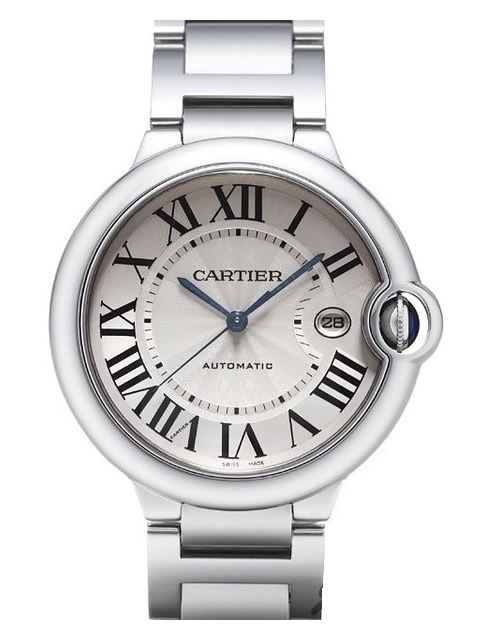
Cartier Ballon Bleu automatic mechanical watch W69012Z4
Review:
◆ The latest version of the Cartier Ballon Bleu W69012Z4, featuring mature replica craftsmanship, with several details refined in this latest edition.
◆ Ballon Bleu is Cartier's most recognisable series and an essential statement piece for social occasions.
◆ The material and craftsmanship of the sapphire crown have been improved. All engravings on the case and bracelet are clearer, closely resembling the genuine article. The lustre of the blued steel hands at specific angles is also comparable to the original.
◆ The dial markings are more precise and carefully executed, representing a minor improvement and showing that the manufacturer has addressed consumer feedback.
◆ On the black chequered dial, the classic Roman numerals at the three and six o'clock positions have been replaced by small sub-dials for minutes and seconds, while the date window has been moved next to the nine o'clock marker. Standard chronograph pushers are positioned on either side of the sapphire crown, allowing you to master the passage of time with every press.
Conclusion: Cartier watches are known for their precision mechanics and exceptional quality, and their professional technology is loved by watch enthusiasts. The Cartier watch recommended to everyone is exquisitely crafted with guaranteed quality. Friends who wish to purchase can add WeChat to consult.
You might also like:
How to wear a Cartier watch? Cartier watch wearing methods
How is the Cartier watch w6900651?
How is the Cartier Ballon Bleu series?
Is the brand awareness of Cartier watches high?
How much does Cartier watch maintenance cost?
![[N Factory Perfect Edition] Rolex Submariner series mechanical watch 116613LN](/images/pic/big/3940.jpg)
![[VS Factory Perfect Edition] Panerai Modern LUMINOR 1950 Series PAM00441 Watch](/images/pic/big/3873.jpg)
![[Noob Factory V7 Edition] Rolex Submariner watch 116610LN Black Sub](/images/pic/big/4977.jpg)
![[Noob Factory V7 Version] Rolex Submariner Watch 116610LV Kermit Submariner](/images/pic/big/4976.jpg)