THE JOURNAL
How do mechanical watches store kinetic energy?
RegardingMechanical watchFor beginner enthusiasts, questions sometimes arise when looking at the timepieces on their wrists. Given that many mechanical watches are now driven by the energy of wrist movements, what is the underlying principle? And how is energy stored so that the hands continue to turn even when the watch is not being worn? Where do features like a three-day power reserve, or even the IWC seven-day power reserve, come from?
1. Energy storage via the mainspring barrel
In fact, the vast majority of our existing mechanical timepieces store energy using a mainspring barrel. The reason a mechanical watch is driven by the energy of wrist movements is that mechanical movements feature an automatic winding mechanism. The principle relies on the weight of the oscillating weight, using inertia when you move to wind the mainspring barrel and store energy. The stored energy is released gradually through the balance wheel and hairspring system rather than all at once, which is why you can see the mechanical watch running continuously.
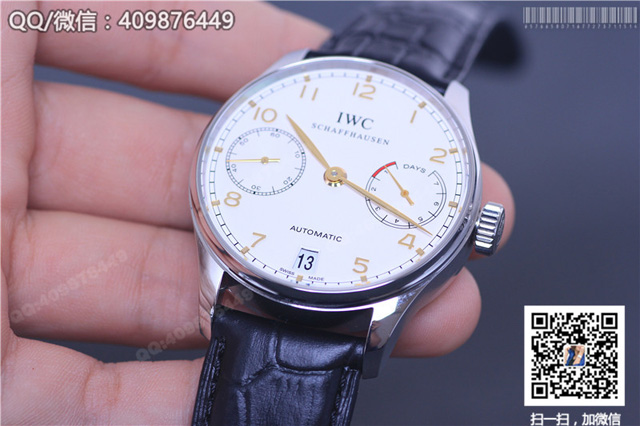
IWC Portugieser Seven Day Power Reserve IW500114customised Cal.51011 movement, 40-hour power reserve
2. Automatic rotor
When you wear a mechanical watch in daily life, actions such as the swinging and moving of your arm will also cause this oscillating weight to turn. Some mechanical systems wind in a single direction, while others wind in both directions. Through the gear train, the potential energy from the rotor's movement is stored in the mainspring barrel. Many high-end watches use precious metals for the rotor precisely because this increases its weight, allowing winding efficiency to be maintained within a smaller volume. Ultimately, working in tandem with the mainspring barrel to continuously release power, the watch keeps ticking away.
A power reserve can also be called a power reserve indicator. Visually speaking, it usually takes the form of a display window on the dial, also known as a power reserve display window. For mechanical watches, it shows how much longer the watch can run before needing to be wound; for quartz watches, it shows the battery level.
Timepieces powered by mechanical mechanisms may develop timekeeping errors or even stop completely if not wound in time. The earliest power reserve indicators appeared centuries ago in marine chronometers, at a time when ships at sea relied on accurate marine chronometers to calculate longitude and ensure navigational safety.
Today, however, the power reserve has undoubtedly become, alongside the tourbillon, one of the hallmarks of watchmakers demonstrating their exceptional craftsmanship. The watch industry evaluates power reserve quality based mainly on two standards: first, long power reserve, meaning the longer the power reserve keeps the watch running, the better; and second, how evenly the energy decreases. If a watch loses energy at an increasingly fast rate, its timekeeping errors will also grow, which is why longer power reserves place higher demands on watchmaking technology.
Related reading:
The Legend of IWC Pilot's Watches
Crafting exclusive masculine charm: Replica IWC watches
I am a post-70 generation and I only like these minimalist, classic mechanical watches
Compared to the "Phelps face", IWC watch dials are much more popular
Demystifying how watches work: why does the second hand of a quartz watch tick in steps?
![[N Factory Perfect Edition] Rolex Submariner series mechanical watch 116613LN](/images/pic/big/3940.jpg)
![[VS Factory Perfect Edition] Panerai Modern LUMINOR 1950 Series PAM00441 Watch](/images/pic/big/3873.jpg)
![[Noob Factory V7 Edition] Rolex Submariner watch 116610LN Black Sub](/images/pic/big/4977.jpg)
![[Noob Factory V7 Version] Rolex Submariner Watch 116610LV Kermit Submariner](/images/pic/big/4976.jpg)