THE JOURNAL
How much do you know about the types of jewels in watch movements?
We often see various jewels inside watch movements, but are the jewels in the movement real? What types of jewels are found in watch movements? If you want to know the answer, let's share the common types of jewels in watch movements below.
What is the purpose of jewels in the movement?
At the dawn of watchmaking and for some time afterwards, the pivots of the escapement, balance staff, and the gear train wheels were directly connected to the brass mainplate or bridges. This not only easily caused wear and tear, but dust in the air could also easily invade the interior of the movement, which in severe cases could even affect the lifespan of the movement. To solve this problem, in 1704, Nicolas Fatio de Duillier, Peter Debaufre and Jacob Debaufre pioneered jewel bearings. They drilled holes into jewels and then placed the gear pivots inside the holes, reducing the friction between the gears and the bridges in the movement to a certain extent. The jewels used at the time were not limited to rubies, but also included diamonds, sapphires, and garnets. However, due to the excessively high cost of natural jewels, only high-end timepieces used them.
Types of watch movement jewels
1. Rubies
The rubies here refer to those on the movement. First, to answer whether these rubies are real: it can be said that nowadays 99.999999% of the rubies in movements are synthetic, and only in a very few top-tier brand watches, such as A. Lange & Söhne, are a small number of genuine stones occasionally fitted to pay homage to watchmaking traditions.
The number of rubies in a watch symbolises its quality. So, is it true that the more rubies, the better? The answer is no. The number of rubies is not, as many believe, "the more the merrier"; and of course, neither is fewer the better. The ruby count in a standard basic movement has a "standard configuration" adapted to mechanical principles, visual effects, and other metrics. The number of rubies in most movements is generally odd because the pallet jewel in the escapement system is singular, while the rest of the rubies essentially come in pairs. In addition, rubies do not only appear in mechanical watches; some quartz movements also have them, but due to their own structural design, quartz movements do not require as many rubies. Therefore, the number of rubies in quartz movements is usually much lower than in mechanical movements.
2. Sapphires
Nowadays, the watch crystals on most timepieces are made of sapphire. Do not think this sounds alluring; in reality, the sapphire in a watch is completely different from natural sapphire. Natural sapphire is a general term for gem-quality corundum in various colours other than ruby, and is precious and rare. A genuine sapphire can be dazzling, but a sapphire watch crystal has no colour at all. The sapphire in watches, also known as sapphire crystal, sounds high-end and looks beautiful, but it is synthetic and essentially glass, also referred to as sapphire crystal glass.
We sometimes also encounter "anti-reflective sapphire". After anti-reflective treatment, sapphire crystals can reduce the reflected light entering the naked eye by 99%, and the element responsible for this is that faint blue coating. Simply put, an anti-reflective crystal is coated with multiple layers on the lens, also known as multi-layer coating or rainbow coating, and is commonly used in professional aviation, diving watches, or watches with heavily curved crystals. There are double-sided anti-reflective glass and single-sided anti-reflective glass; the difference is that the former is coated on both the inner and outer sides of the crystal, whereas the latter is coated only on the inner side of the glass, with little difference in effectiveness between the two. It should be noted that the coating can be rubbed off, so avoid cleaning with rough objects.
Luxury brand watch recommendations
[N Factory V8 Perfect Edition] Audemars Piguet Royal Oak Offshore Sports Watch 15703ST.OO.A002CA.01
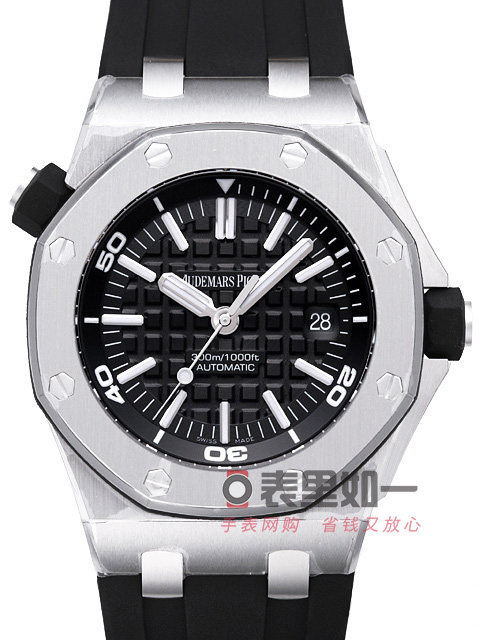
N Factory Three Musketeers - A work of substance
Price: (Please contact customer service for the latest price)
Series:Royal Oak Offshore Series
Movement: Citizen 9015
Strap: Rubber strap
Case: Stainless steel
Clasp: pin buckle
Bezel: Standard
Crystal: Sapphire crystal glass
Diameter: 42MM
Water resistance: 100 metres
Review:
◆ A watch with a very high degree of completion, featuring a 99% similarity to the genuine article. Compared to the previous version, the angles of the bezel screws on the front are more precise.
The printing and reflective effect of the date display are now more similar to the genuine article.
The dial and indices are identical to the genuine version, successfully recreating the beautiful, textured three-dimensional relief found on the original.
◆ The craftsmanship of the Royal Oak Offshore lettering on the case back has also been enhanced.
Conclusion:Today, in watch movements, both rubies and sapphires are relatively common jewels. These jewels are generally synthetically produced, yet they play an irreplaceable role within the watch.
To view more one-to-one replica watch models, please click:One-to-one replica luxury watches、1:1 replica watches、Replica world-famous watches、High-grade replica world-famous watches、Replica luxury watch、High-grade replica Swiss watches、Fine replica luxury watches、Fine replica world-famous watches、Fine replica Swiss watches
Related reading:
What is the shock-absorbing principle of a watch movement?
How many watch maintenance misconceptions do you know?
Where did the world's first wristwatch come from?
Clean your watch bracelet and give your timepiece a new lease of life
![[N Factory Perfect Edition] Rolex Submariner series mechanical watch 116613LN](/images/pic/big/3940.jpg)
![[VS Factory Perfect Edition] Panerai Modern LUMINOR 1950 Series PAM00441 Watch](/images/pic/big/3873.jpg)
![[Noob Factory V7 Edition] Rolex Submariner watch 116610LN Black Sub](/images/pic/big/4977.jpg)
![[Noob Factory V7 Version] Rolex Submariner Watch 116610LV Kermit Submariner](/images/pic/big/4976.jpg)