THE JOURNAL
What materials are mechanical watch movements generally made of?
What materials are mechanical watch movements generally made of?
The workmanship of mechanical watch movements is constantly improving nowadays, and the materials used for watch movements are also constantly changing. So what materials are mechanical watch movements generally made of nowadays? Below, Xiaoya will popularise some relevant knowledge about mechanical watch movement materials for everyone.
Mechanical watch movement material type one: Copper alloys
Red copper is pure copper, also known as red brass.
Brass is an alloy composed of copper and zinc, and is the most common and highest-content metal used in watch materials. The main plates and bridges of the vast majority of watch movements are machined from brass. Brass can also be used to make the gears inside the movement.
Lead brass is brass with added lead, designed to improve the machinability of the brass. This type of lead brass is mainly used to make the mainplates and bridges of watch movements.
Cupronickel is a copper-based alloy with nickel as the primary additive element. It has a silvery-white appearance, hence its name.
Tin bronze is a bronze with tin as the main alloying element. The tin content generally ranges between 3 and 14%, and it is mainly used to make resilient components and wear-resistant parts.
Mechanical watch movement material two: tungsten alloy
The solid-state density of tungsten is 19.25 grams per cubic centimetre. Combined with nickel, iron, copper and other elements to create a high-density alloy, this alloy has a density more than twice that of copper or steel. This alloy is primarily produced for making the rotor segments of automatic watches, because the greater the density of the rotor segment, the more the winding efficiency can be improved.
Mechanical watch movement material three: steel
Steel is also used extensively within the movement, including various springs, gears, pinion shafts, winding stems, and minute and hour wheels...
Mechanical watch movement material four: elinvar
Elastic alloys are generally divided into high-elasticity alloys and constant-elasticity alloys. The former requires a high elastic limit, low anelastic effect, and good heat resistance, allowing it to work at higher temperatures; the latter requires the modulus of elasticity to remain virtually unchanged with temperature within a certain temperature range.
High-elasticity alloys are used to make mainsprings, storing energy for the operation of the movement.
The notable difference between constant-elasticity alloys and other metal materials is that their modulus of elasticity remains constant or has an absolute value close to zero within a certain temperature range. Using constant-elasticity alloys can greatly reduce the impact of external temperatures on the timekeeping accuracy of watches. Constant-elasticity alloys are further classified into weakly magnetic and non-magnetic according to their magnetic sensitivity.
Mechanical watch movement material five: precious metals
The precious metals used inside the movement are primarily gold, platinum and rhodium. Due to their high density, gold and platinum are mainly used to make oscillating weights to improve winding efficiency, and antique pocket watches have also used gold to make balance springs, gears, and gold chatons. Rhodium, on the other hand, is used for electroplating.
Vacheron Constantin Overseas 21k gold rotor segment
Mechanical watch movement material six: natural gemstones
Natural gemstones are also used in movements, but mostly in pocket watches. The reason for this is that synthetic gemstones are not only inexpensive and suitable for mass production, but they also boast superior quality without the flaws commonly found in natural gemstones. Some high-end modern watch movements still use a small number of natural gemstones.
Mechanical watch movement material seven: plastic
Engineering plastics are lightweight, self-lubricating, have low friction, and are anti-magnetic.
Mechanical watch movement material eight: silicon
Silicon began to be associated with watch movements only in the last 20 years, with Ulysse Nardin first introducing a silicon escapement wheel in 1999. Afterwards, balance springs were also manufactured using silicon. Silicon is a new type of material that is anti-magnetic, low in density, and wear-resistant.
Having read the above, Xiaoya recommends a top-tier replica mechanical watch here for everyone, and interested friends are welcome to take a look.
Jaeger-LeCoultre Master Ultra Thin Q1372520
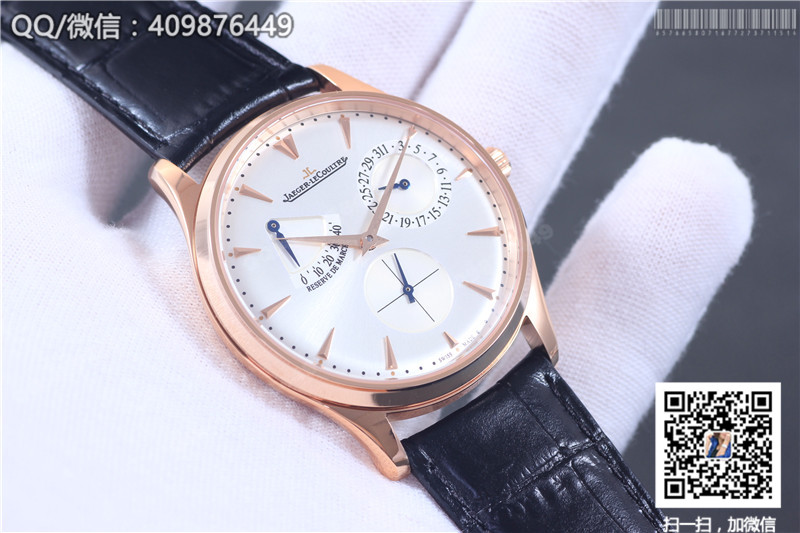
Price: (Please contact customer service for the latest price)
Series:Master collection
Movement: Automatic mechanical movement
Strap: calfskin strap / American alligator leather (available to order upon payment)
Case: 18 rose gold-plated
Clasp: Folding clasp
Crystal: Sapphire crystal glass
Diameter: 39MM
Review:
The small subdial in the top left corner is the 40-hour true power reserve display, while the right side features a circular date ring, and the seconds display subdial is positioned at the bottom of the dial, delivering impressive practical performance.
While the silver dial certainly offers a superb metallic aesthetic, true refinement and luxury come from the meticulously carved components that support a strikingly three-dimensional dial structure.
The three subdials are indicated by blued steel hands, displaying the date, small seconds, and power reserve respectively, with near-perfect proportions.
◆ Both the finishing techniques and the artistic appreciation value are far superior to the steel models. Thinking about this, purchasing the rose gold version becomes much easier to justify.
Overall, the primary material used for mechanical watch movements remains brass, along with many other materials which we will not list individually. If you wish to purchase a top-tier replica mechanical watch first, you are welcome to scan the QR code to add our WeChat for enquiries.
Related reading:
Jaeger-LeCoultre MASTER CONTROL series Q1368420 automatic mechanical watch
What do you need to pay attention to when setting the time on a mechanical watch?
How often should a mechanical watch be serviced?
What should be considered when purchasing a mechanical watch?
What to do if an automatic mechanical watch stops running?
![[N Factory Perfect Edition] Rolex Submariner series mechanical watch 116613LN](/images/pic/big/3940.jpg)
![[VS Factory Perfect Edition] Panerai Modern LUMINOR 1950 Series PAM00441 Watch](/images/pic/big/3873.jpg)
![[Noob Factory V7 Edition] Rolex Submariner watch 116610LN Black Sub](/images/pic/big/4977.jpg)
![[Noob Factory V7 Version] Rolex Submariner Watch 116610LV Kermit Submariner](/images/pic/big/4976.jpg)