THE JOURNAL
Which is better, Rolex or Cartier?
IfRolexandCartierwe make a comparison, what would the outcome be? This is undoubtedly a question that many friends frequently encounter, and even one that many watch enthusiasts—whether beginners or seasoned collectors—often contemplate. Today, we will explore this question together, explained in a way that is accessible to readers of all backgrounds.
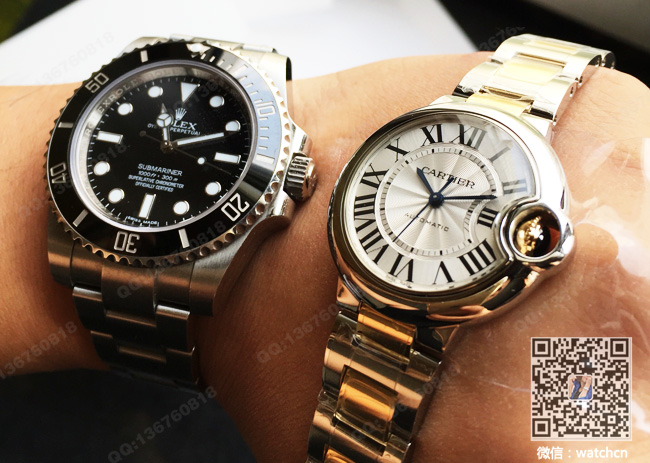
First, in terms of appearance
Assuming we are merely comparing aesthetics, unless one has a specific bias towards Rolex, most people viewing from a conventional aesthetic standpoint would likely choose Cartier. Compared to Rolex's relatively traditional watch designs, Cartier's styling—whetherCartier Ballon Bleu seriesor the Tank collection—exudes a strong sense of style. Although the Tank series has a history spanning nearly a century, its unconventional design has withstood the relentless test of time, remaining at the forefront of fashion with enduring freshness. In contrast, Rolex's aesthetic—or rather the design of mainstream Rolex watches—largely inherits the traditional shape created by the Oyster structure, which is relatively conventional. Therefore, in this dimension, Cartier holds the advantage.

Rolex Daytona collection 116520, 40mm, 100 m water resistance
Second, in terms of craftsmanship
Mechanical watches can generally be divided into basic movements and complex movements. In the realm of basic movements, Rolex excels to such an extent that there is a saying, "Once a Rolex, always a Rolex." This is because Rolex devotes nearly all its energy to enhancing accuracy and continuously refining the watch's "three defences" (water resistance, shock resistance, and magnetic resistance). As a result, nearly half of all watches currently certified by COSC are Rolex products, with the remaining half split among all other participating brands—an achievement that is truly remarkable. Furthermore, the record for the deepest diving watch is currently held by Rolex, proving that its performance in the "three defences" is indeed extraordinary.
Although Cartier may not be as outstanding as Rolex in basic movements—and some entry-level Cartier models even use quartz movements—Cartier has achieved significant success in complex movements, another key indicator of watchmaking skill. This includes top-tier complications such as minute repeaters and tourbillons. Therefore, while each has its strengths, Rolex wins in terms of its overall contribution to watchmaking craftsmanship.

Third, in terms of brand
Although both are representative brands of high-end watchmaking, their brand identities differ. When Cartier is mentioned, many people first think of jewellery rather than watches; many women wear the Ballon Bleu with a quartz movement. In this sense, Cartier is often perceived more as 'decorative'. Rolex is different; it is known as a professional watchmaking company that almost exclusively produces mechanical movements in-house. Its iconic models, such as the Submariner and Datejust, are known for their durability. A slight drawback is that for some, the 'nouveau riche' image is too prominent, leading those who prefer a low-key profile to avoid Rolex. Overall, as a pure watchmaking brand, Rolex wins.
Overall evaluation: When comparing Rolex and Cartier, although each still has its own merits to a large extent, and each holds different advantages from different perspectives, for devoted watch enthusiasts who have already lost their hearts to one, every favoured brand holds an irreplaceable status.
![[N Factory Perfect Edition] Rolex Submariner series mechanical watch 116613LN](/images/pic/big/3940.jpg)
![[VS Factory Perfect Edition] Panerai Modern LUMINOR 1950 Series PAM00441 Watch](/images/pic/big/3873.jpg)
![[Noob Factory V7 Edition] Rolex Submariner watch 116610LN Black Sub](/images/pic/big/4977.jpg)
![[Noob Factory V7 Version] Rolex Submariner Watch 116610LV Kermit Submariner](/images/pic/big/4976.jpg)