THE JOURNAL
What is the acceptable accuracy tolerance range for a mechanical watch?
Anyone relatively familiar with watches should know thatMechanical watchtimekeeping deviations are larger than those of quartz and electronic watches. For individuals seeking high precision, it can take some getting used to initially, and noticing a deviation might make you think something is wrong with your watch. In reality, a mechanical watch's deviation is reasonable as long as it stays within acceptable parameters, so there is no need to worry unduly. Let us discuss what constitutes a reasonable accuracy range for a mechanical watch.
What is a reasonable accuracy deviation for a mechanical watch
First, one must understand that the oscillating element in a quartz watch is quartz, which possesses a fixed vibration frequency. This frequency determines the oscillation period, and the period dictates the time taken for a single vibration, making quartz watches very accurate due to their constant frequency. In contrast, mechanical transmissions derive their power from a mainspring. Factors such as gravity, magnetic fields, and metal fatigue can cause irregularities in mechanical transmission, making minor deviations in mechanical watches entirely normal.
So what constitutes a reasonable range? The permitted accuracy tolerance for a mechanical watch is ±30 seconds per day, COSC-certified movements maintain an average daily error between -4 seconds and +6 seconds, while Rolex generally keeps it within 5 seconds. The power reserve of an automatic mechanical watch comes from the movement of the wearer's wrist, which generates energy to wind the mainspring. A fully wound automatic watch can run for approximately 36 hours; if worn normally every day, it will operate for around 15 hours. Leaving it unworn beyond this timeframe or failing to wind it sufficiently due to low physical activity will cause the watch to stop, and it should be fully wound before being worn again.
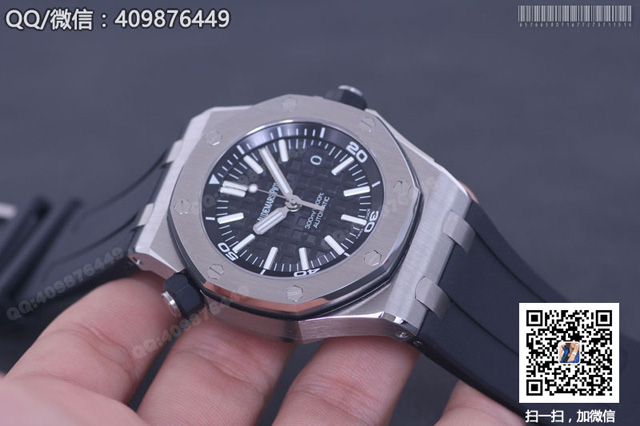
Audemars Piguet Royal Oak Offshore Sports Watch 15703ST.OO.A002CA.01, 42mm case diameter, stainless steel case, 100 m water resistance, mechanical movement
Situations involving timekeeping deviations
1. The accuracy of a watch varies depending on its movement type. Quartz watches use a quartz oscillator instead of the balance wheel found in mechanical watches, utilizing its precise high-speed oscillation to keep time. Generally speaking, quartz watches have higher accuracy, with the Swiss standard being a monthly error within 15 seconds, and some highly precise movements can even achieve an annual error within just a few seconds.
2. Mechanical watches rely on internal mechanical components to control the steady and accurate timekeeping of the watch. These mechanical components are affected by gravity, ambient temperature, and other factors, which cause errors. Generally, the error of a mechanical watch is calculated daily and varies depending on the movement model and manufacturing quality. Typically, a daily error within 30 seconds is considered within the normal range.
3. The timekeeping accuracy of a mechanical watch cannot be achieved or maintained through calibration. Why is this? It is because the timekeeping of a mechanical watch is constantly changing. Relative to a specific mainspring tension, a fixed position, and a certain temperature, it can be temporarily accurate, but once conditions change to another state, it will immediately behave differently. In other words, even if a watch is calibrated to be accurate to the second, it will not stay that way; accuracy is always changing instantaneously and in fluctuations. Moreover, there are many other factors that affect the accuracy of a watch, so the watch error can only be an average error of actual running over a unit of time.
In addition, mechanical watches achieve their best timekeeping accuracy when the mainspring is fully wound. It is worth emphasising that the error of a watch depends on the movement standard used in the watch, rather than the principle that the higher the price of the watch, the smaller the error. Even a Patek Philippe worth hundreds of thousands is not necessarily more accurate in timekeeping than a replica watch costing a few thousand!
Related reading:
Mechanical watches free from radio interference
How to maintain the precision of mechanical watches?
Reasons why mechanical watches experience inaccurate timekeeping
My Omega Seamaster is inaccurate; why is this?
How to keep your mechanical watch running smoothly for a long time
![[N Factory Perfect Edition] Rolex Submariner series mechanical watch 116613LN](/images/pic/big/3940.jpg)
![[VS Factory Perfect Edition] Panerai Modern LUMINOR 1950 Series PAM00441 Watch](/images/pic/big/3873.jpg)
![[Noob Factory V7 Edition] Rolex Submariner watch 116610LN Black Sub](/images/pic/big/4977.jpg)
![[Noob Factory V7 Version] Rolex Submariner Watch 116610LV Kermit Submariner](/images/pic/big/4976.jpg)