THE JOURNAL
How to Wind a Manual Mechanical Watch?
A manual mechanical watch is driven by manually winding the mainspring. However, friends who are new to mechanical watches might not be clear on how to wind them. Below, Xiaoya shares the method for winding manual mechanical watches for your reference.
Winding Method for Manual Mechanical Watches
Manual mechanical watches are usually wound by turning the crown to tighten the mainspring inside the watch. The mainspring system then releases kinetic energy to drive the watch's timekeeping functions. All of these processes are completed through mechanical principles and structures.
A fully wound mainspring can typically keep a watch running for over 30 hours, with some even lasting up to eight days or more. If you want the watch to run continuously, you must pay attention to winding the mainspring at any time; however, overwinding can cause damage to the watch. Therefore, it is generally recommended to wind it fully only once a day. Some even suggest winding it at the same time every day, because temperature variations at different times can affect the mainspring, and doing so helps to better maintain the watch.
Winding Direction for Manual Mechanical Watches
Generally, when we say the watch dial is facing up, the right hand rotates the crown, with the thumb turning either upwards or downwards.
In fact, the direction of the crown can be simply explained in two scenarios. In the first scenario, when the crown is not pulled out, turning it upwards should wind the watch, while turning it downwards is neutral, having no effect, so turning it freely does no harm. In the second scenario, when pulled out by one click, turning the crown upwards should rotate the minute hand anti-clockwise, while turning it downwards rotates the minute hand clockwise. However, this is not absolute. Often, watches with a date function allow the crown to be pulled out by multiple clicks; sometimes the first click adjusts the time, and sometimes the second click adjusts the time, so turning downwards might rotate the minute hand anti-clockwise, and turning upwards might rotate it clockwise. In this case, if there is a calendar or moon phase, it is highly recommended not to turn the crown to rotate the minute hand anti-clockwise, especially when the date is jumping. This could damage the calendar or moon phase driving yoke. If there is no calendar or moon phase, it does not really matter, and adjusting the time anti-clockwise or clockwise is perfectly fine. As for the internal structure when turning the crown anti-clockwise, it is nothing more than a combination of a one-way clutch and gears. In the neutral position, forward rotation drives the mainspring gear train, while reverse rotation engages the one-way clutch to idle. When adjusting the time, the mainspring power is disconnected, so forward and reverse rotations are the same. The key is that if the calendar yoke is in motion, this yoke mechanism has a dead point; often, forward movement is fine, and reverse movement is also fine, but reversing midway through the movement will hit the dead point, which can easily bend or damage the yoke. Consequently, the calendar might stop halfway through jumping in the future, or simply stop jumping altogether. As for the moon phase, the watch cannot be adjusted while the moon phase is moving, neither forwards nor backwards. The principle is the same as the calendar.
Winding only goes in one direction, while the other direction idles. How many turns generally? This depends on the power reserve of the watch. If it is a 38-46-hour power reserve mainspring, it generally takes about 30-40 turns. This is a vague concept. Modern ETA automatic movements all have overload protection, so once fully wound, further winding just idles. So wind with peace of mind. Some manual watches do not have overload protection, and once fully wound, the crown can no longer be turned.
Recommended Top-Tier Replica Mechanical Watches
[Top replica] Omega De Ville series men's mechanical watch 424.13.40.20.02.001
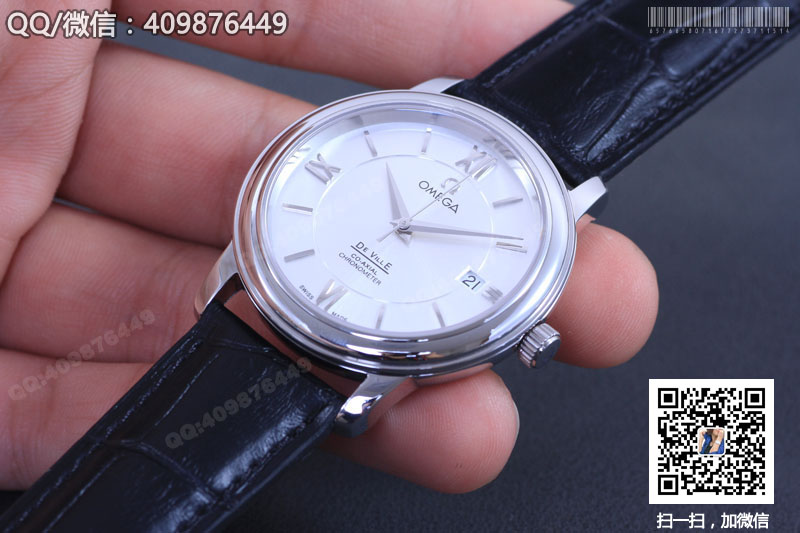
Series:De Ville collection
Movement: Replica ETA2824 movement
Strap: calfskin strap
Case: Stainless steel
Clasp: pin buckle
Crystal: Sapphire crystal glass
Diameter: 39MM
Water resistance: 30 metres
Review:
◆ A very enduring De Ville; the 9.5 mm case diameter is just right for men. The silvery-white dial with Roman numerals gives a very vintage feel. The watch is very thin, and a pin buckle suits it better. Meanwhile, the black leather strap complements the silver watch, making it elegant without being rigid.
◆ Features 30 metres of water resistance, making swimming with the watch completely fine.
◆ Adopts a replica ETA2824 movement, ensuring accurate timekeeping.
◆ Exquisitely simulated appearance with a definite enhancement in fidelity.
The above is the winding method for manual mechanical watches. If you wish to purchase top-tier replica mechanical watches, you are welcome to scan the QR code to add us on WeChat for details.
Related reading:
V6 Perfect Edition] Omega Hour Vision De Ville Series Men's Mechanical Watch 431.33.41.21.03.001
Why Do Mechanical Watches Use Jewels?
What materials are mechanical watch movements generally made of?
What is the true charm of mechanical watches?
Do automatic mechanical watches require servicing?
![[N Factory Perfect Edition] Rolex Submariner series mechanical watch 116613LN](/images/pic/big/3940.jpg)
![[VS Factory Perfect Edition] Panerai Modern LUMINOR 1950 Series PAM00441 Watch](/images/pic/big/3873.jpg)
![[Noob Factory V7 Edition] Rolex Submariner watch 116610LN Black Sub](/images/pic/big/4977.jpg)
![[Noob Factory V7 Version] Rolex Submariner Watch 116610LV Kermit Submariner](/images/pic/big/4976.jpg)