THE JOURNAL
Are watches toxic? What do you know about the luminescence materials on replica watches?
The invention of the watch was intended to make life more convenient, but reading the time in the dark remains a hassle, requiring an external light source. Consequently, some began applying fluorescent materials to the hands and the hour markers on the dial, allowing for easy time reading at night.
Traditional fluorescent coating materials can be divided into self-luminous and light-storing types. Self-luminous fluorescent agents rely on trace radioactive substances to release radiation that excites the fluorescent agent to glow. Light-storing fluorescent agents contain virtually no radioactive substances but require prior exposure to external light of sufficient intensity to excite their electrons from a low energy level to a high energy level, where they are stored. When the surrounding environment is dark, the energy is slowly released as the electrons transition back from a high to a low energy level, causing the fluorescent agent to glow. Because light-storing types do not carry radiation-exciting materials, their afterglow duration is currently not as long as the self-luminous type.
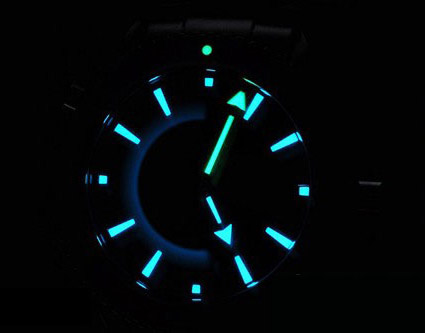
Radium luminescence
Very few early pocket watches featured luminescence. The true popularity of luminescence is inextricably linked to the gradual proliferation of military instruments during wartime. Without luminescence, reading the time during night marches or in dark environments was extremely difficult; using a torch or other light source would be very dangerous, so luminous watches were born out of necessity. Early fluorescent coatings commonly used radioactive radium salts as an exciter. Radium is a standard radioactive and highly toxic substance; even with minimal usage and the protection of the watch crystal, it could still pose a risk to human health. Due to its inherent radioactivity, its use has been gradually restricted, and it is now being phased out.
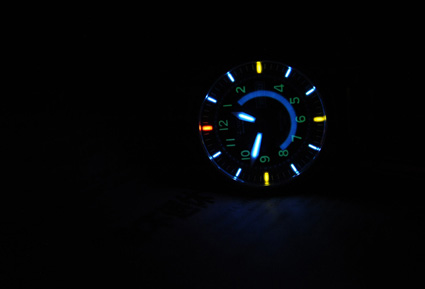
Tritium luminescence
With the popularity of luminous watches, the watch industry began to adopt tritium (Tritium)—— as a luminous material. Tritium is an isotope of hydrogen; like radium, it is radioactive, but its radioactivity is much lower and much safer than that of radium. Tritium is also used in the manufacture of thermonuclear weapons, but its β decay only releases fast-moving electrons, which do not penetrate the human body. Only heavy contact with and inhalation of tritium (3H or T) can cause harm to the human body. We often see the luminescence on vintage watches turning yellow, which is the aging of tritium luminescence.
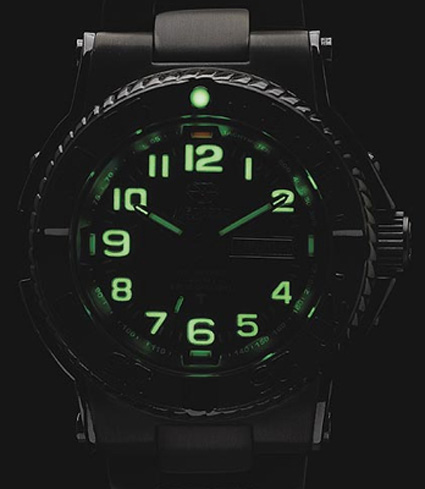
Tritium tube luminescence
Micro tritium gas tubes, which are popular in the military watch sector, are actually called “Tritium Gas Vial”. They were adopted as a standard specification for US military watches starting in 1989 and remain very popular today. Pure tritium gas is sealed in a very safe and stable form inside a micro mineral glass tube whose inner wall is coated with a cold-glow substance. When the electrons emitted by the tritium excite the cold-glow substance on the inner wall of the tube, the tube emits light that is 100 times brighter than traditional coated luminescence, allowing the wearer's eyes to easily read the dial in the dark without needing to adjust.
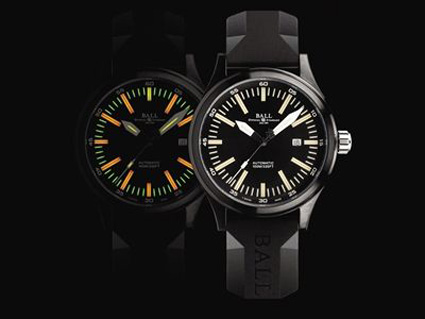
Luminova luminescence
Since the 90s, with technological development and progress, a new type of long-afterglow, light-storing, rare-earth-based alkaline earth aluminate fluorescent material free of radioactive substances has emerged. This is the now very popular Luminova. Luminova is a non-radioactive, eco-friendly material first developed by Japan's Nemoto & Co. in 80. Its basic chemical composition is inorganic aluminate, and it has extremely strong light resistance, will not discolour over long periods, and possesses excellent chemical stability, meaning it will not turn yellow even after years of use. Because it is fundamentally different from traditional sulphide-type and radiation-excited luminous materials, containing absolutely no harmful elements, its chemical properties are more stable, its brightness is high, and its afterglow duration is long. Ideally, Luminova can be mixed with various colours, such as pink, blue, yellow, red, and so on, to create colourful luminous effects, adding many rich elements to watch design. Meanwhile, higher-endReplica watchesalso frequently adopt this substance.
![[N Factory Perfect Edition] Rolex Submariner series mechanical watch 116613LN](/images/pic/big/3940.jpg)
![[VS Factory Perfect Edition] Panerai Modern LUMINOR 1950 Series PAM00441 Watch](/images/pic/big/3873.jpg)
![[Noob Factory V7 Edition] Rolex Submariner watch 116610LN Black Sub](/images/pic/big/4977.jpg)
![[Noob Factory V7 Version] Rolex Submariner Watch 116610LV Kermit Submariner](/images/pic/big/4976.jpg)