THE JOURNAL
Does cold weather affect the timekeeping accuracy of mechanical watches?
As is well known,Mechanical watchtimekeeping will more or less have a corresponding error, known in the industry as the daily rate. This is caused by many factors, such as the tightness of the mainspring causing its energy output torque to vary; the fact that a watch is, after all, a mechanical device with frictional resistance; and the influence of the escapement mechanism, primarily on the balance wheel and hairspring system during the energy transmission process. The balance wheel and hairspring system can only maintain a fixed oscillation frequency under free oscillation conditions; clearly, the energy transmission process of the escapement mechanism will affect the oscillation frequency. Of course, magnetic fields and temperature also have a certain degree of influence, amongst other things.
Does temperature change affect the timekeeping of mechanical watches?
The effect of temperature changes on mechanical watches is essentially twofold: it impacts the internal metal components and the lubricating oil that reduces frictional resistance within the movement. We all know a common fact: metals expand with heat and contract with cold. For a watch movement, which is a precision instrument, this is especially significant for elastic parts such as the mainspring, balance wheel and hairspring. Changes in temperature alter the geometric dimensions of the balance wheel and hairspring, and every tiny change in these critical parts directly affects the oscillation period. The mainspring is a relatively vulnerable component in the movement. In the past, watch mainsprings were made of carbon steel; as the tightly wound mainspring inside the barrel expanded and contracted with temperature changes, it could cause the mainspring to break. Modern watch mainsprings are now made of "white steel". This so-called "white steel" mainspring is a type of stainless steel, referred to by the Swiss as "NIVAFLEX", which is a complex nickel-based metal alloy where the influence of temperature has been rendered negligible.
Temperature affects the balance wheel and hairspring
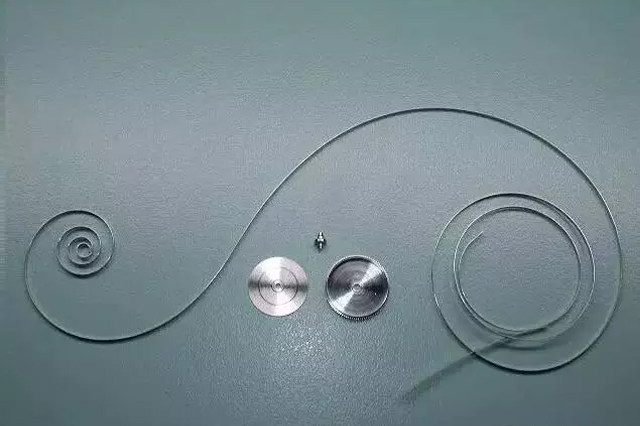
Next, let us talk about the balance wheel and hairspring. The metallurgical name for the material used in hairsprings is constant-elasticity alloy. Its significant difference from other metal materials is that its elastic modulus remains constant, or its absolute value is close to zero, within a certain temperature range. Early hairsprings were made of low-carbon steel, a material extremely sensitive to temperature and magnetic fields. Using such hairsprings could cause a watch to gain or lose several minutes a day. When the ambient temperature rose, the low-carbon steel hairspring would lengthen, causing the watch to run slow; when the ambient temperature dropped, the hairspring would shorten, causing the watch to run fast. According to calculations, with the earliest steel balance wheels and hairsprings, a temperature rise of 60 degrees Fahrenheit (approximately 33 degrees Celsius) would cause the watch to lose 393 seconds a day, which is 6 and a half minutes. Is this acceptable to you?
To solve this problem, the ingenious watchmakers of the past adopted the "cut bimetallic compensation balance wheel". The so-called "cut" refers to two cuts near the balance arm, serving as a buffer for the thermal expansion and contraction of the metals. The outer layer of this balance wheel is brass, accounting for about 2/3 of the thickness, while the inner layer is steel, accounting for 1/3. The two metals have different coefficients of expansion. When the temperature rises, the expansion coefficient of the brass outer layer is greater than that of the steel inner layer, forcing the balance rim to bend inwards at the cuts. This reduces the radius of the balance wheel and decreases its moment of inertia, thereby compensating for the changes in the hairspring, whose elasticity and length alter with the rising temperature. When the temperature drops, the contraction coefficient of the brass outer layer is greater than that of the steel inner layer, forcing the balance rim to bend outwards. This increases the effective radius and the moment of inertia, compensating for the changes in the hairspring, which accelerates due to the low temperature. Simply put, when the temperature rises and the hairspring becomes softer, the diameter of the balance wheel becomes smaller, and the two cancel each other out. This is known as Cold and Heat Adjustment.
Developing new materials to reduce the effects of temperature
With the passage of time, physicist Charles Édouard Guillaume developed the nickel-iron alloy Invar in 1896. Later, in 1904, when 12% chromium was added to the nickel-iron alloy, the absolute value of the alloy's thermal expansion coefficient approached zero, and the coefficient changed extremely gently within room temperature range. In 1930, the Nivarox alloy was further improved on the basis of Invar. The daily rate accuracy limit of balance wheels and hairsprings using Nivarox under temperature influence is 0.3 seconds. Later, scientists discovered the rare element beryllium. The beryllium-copper alloy, combining beryllium and copper, brought a qualitative leap to copper. Its thermal expansion and contraction are almost zero, it is highly corrosion-resistant, has exceptionally high hardness, and has a slightly darker colour similar to rose gold. It is currently the most widely used material for balance wheels, known as the Glucydur beryllium-copper balance wheel.
Although the factors mentioned above are constantly being improved and upgraded, the influence of temperature has not been absolutely eliminated. Of course, for fine brands, the variation error is already within the range of COSC (Official Swiss Chronometer Testing Institute) — measuring the daily rate in environments of 8 degrees Celsius and 38 degrees Celsius, subtracting the daily rate of the low-temperature environment from that of the high-temperature environment, and then dividing by 30 yields a daily rate variation caused by temperature of less than 0.6 seconds/day. This shows that errors still exist, but ingenious scientists have introduced even better materials. These include the Parachrom hairspring introduced by Rolex in 2000, which is made of an exclusive niobium-zirconium alloy. It contains no metals prone to magnetisation and has a relatively high hardness, so its anti-magnetic capability is multiplied, and its temperature resistance is also excellent, making it resistant to thermal expansion and contraction. Additionally, there is the silicon escapement system jointly developed by several watchmaking brands in 2006, which also includes the silicon hairspring. The use of silicon has truly avoided the influence of temperature changes on movement parts.
Temperature alters the viscosity of the lubricant inside the watch movement
But let us not forget another factor: temperature also alters the viscosity of the lubricant inside the watch movement, thereby changing the torque transmission and oscillation of the mechanical watch gear train. Lubricant (watch oil) is extremely important for a watch. To reduce the frictional resistance and wear of the rotating parts in the watch, lubricant is added to the gear train bearings, the working faces of the pallet jewels, and the shock absorbers of the balance wheel, so as to improve the energy transmission efficiency and working efficiency of the watch mechanism. If the temperature changes, the lubrication conditions will also change:
When the temperature rises above 50 degrees, the lubricant will not only spread and run off rapidly due to decreased viscosity, but will also oxidise, deteriorate, and volatilise, losing its lubricating effect and affecting the timekeeping performance of the watch.
When the temperature drops, the viscosity of the lubricant increases, and the frictional resistance rises. As a result, on one hand, the energy transmission efficiency decreases, and the amplitude of the balance wheel is reduced; on the other hand, the frictional resistance of the balance-spring system increases, affecting the timekeeping accuracy of the watch and causing it to run slow.
Most lubricants used in watches have already taken the effects of temperature changes into account, and there is almost no problem in non-extreme temperature environments (from a few degrees below zero to 50 degrees above zero). However, many countries or regions are in frigid zones where winter temperatures are extremely low, which will have a certain impact. But generally, our watches are worn on the wrist or kept indoors, so there is no need to worry too much about the effect of temperature changes on the lubricant inside the movement. Of course, if a watch is worn by our astronauts during spacewalk missions, the lubricant for this watch is a specially customised low-temperature watch oil, such as that used in the Omega Moonwatch.
In summary, cold weather does affect the timekeeping accuracy of mechanical watches, and the daily rate will speed up accordingly, but generally by only 1 to 2 seconds per day. This is not too unreasonable, is it?
Related reading:
Why do mechanical watches have errors?
How do mechanical watches store power?
What is the permissible timekeeping error range for a mechanical watch?
![[N Factory Perfect Edition] Rolex Submariner series mechanical watch 116613LN](/images/pic/big/3940.jpg)
![[VS Factory Perfect Edition] Panerai Modern LUMINOR 1950 Series PAM00441 Watch](/images/pic/big/3873.jpg)
![[Noob Factory V7 Edition] Rolex Submariner watch 116610LN Black Sub](/images/pic/big/4977.jpg)
![[Noob Factory V7 Version] Rolex Submariner Watch 116610LV Kermit Submariner](/images/pic/big/4976.jpg)