THE JOURNAL
Why are gold-filled watches much more expensive than gold-plated ones?
Why are gold-filled watches very expensive while gold-plated ones are cheaper, and what is the difference? First, let us understand what gold plating and gold filling are.
I. What is watch gold plating? What is PVD technology?
Gold plating involves applying a very thin layer of gold to watch materials (including the case, bezel, case back, clasp, and crown), usually measured in microns. International standards for standard gold plating are 2-3 microns, while thick gold plating is 10-25 microns. Thick gold plating is much more durable and resistant to fading, especially with PVD. PVD (Physical Vapour Deposition) uses arc discharge technology in a vacuum to deposit material onto the workpiece, resulting in higher hardness, wear resistance, and corrosion resistance. PVD is more durable than traditional water plating and does not flake off in large patches, though it may fade slowly over time. For the same thickness, PVD is about 5 times more wear-resistant than traditional plating, which is why it is now standard. The longevity of PVD depends on the thickness; it is rare to see it fade within a few years, though excessive sweating or contact with chemicals can affect its lifespan.
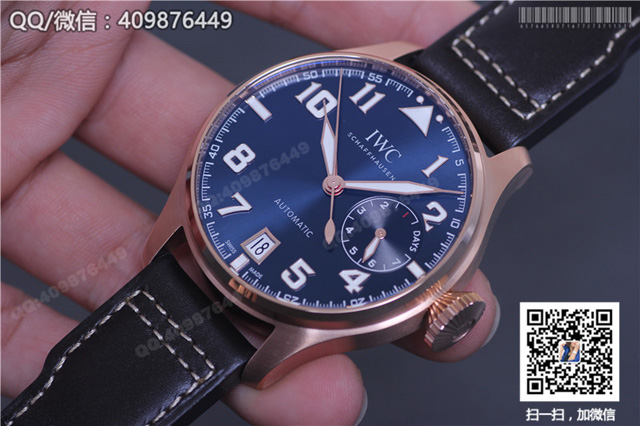
V6 New IWC Pilot's series IW500909 rose gold model
Watch collection: Pilot
Movement Type: automatic mechanical
Gender: Men's
Case material: Rose gold-plated
Strap Material: Calfskin strap
Case diameter: 46 mm
Watch price: $447.21 USD
II. What is watch gold filling? What colours are available for gold-filled watches?
Gold filling involves mechanically pressing or heat-bonding a thin layer of gold or K-gold foil onto the watch material. Because the thickness is often ten to several dozen times that of gold plating, the colour is much purer and indistinguishable from solid gold; many gold-filled watches will not fade even after decades of wear. However, due to the high gold content (the gold mass must be no less than 10% of the watch's total mass) and complex craftsmanship, the cost is relatively high. A well-made gold-filled watch usually requires about 10-15 days for production; if the production time is too short, the gold layer is prone to flaking off later.
Rolled gold comes in a variety of shades, predominantly pure yellow gold, rose gold and white gold. Pure yellow gold is mainly based on 18K gold, whilst rose gold refers to the colour produced by blending 75% yellow gold with 25% copper. Therefore, unless one is overly particular, standard gold-plated watches are usually sufficient to meet most people's daily wearing needs.
Related reading:
Determining watch performance and stylistic appearance from different watch materials
What are gold-plated watches like? Do gold-plated watches fade?
Things you didn't know about watch materials
The difference between genuine gold and PVD gold plating in replica watches
The beauty of materials and exquisite craftsmanship create true consistency inside and out
![[N Factory Perfect Edition] Rolex Submariner series mechanical watch 116613LN](/images/pic/big/3940.jpg)
![[VS Factory Perfect Edition] Panerai Modern LUMINOR 1950 Series PAM00441 Watch](/images/pic/big/3873.jpg)
![[Noob Factory V7 Edition] Rolex Submariner watch 116610LN Black Sub](/images/pic/big/4977.jpg)
![[Noob Factory V7 Version] Rolex Submariner Watch 116610LV Kermit Submariner](/images/pic/big/4976.jpg)